Women’s Voices in Rune Singing
Kerttu Sormunen is a singer with Idrîsî Ensemble and led a session in our Arts Council England-supported free workshop series on Finnish rune-singing. Here, she reflects on runolaulu and “All My Joys I Have Forgotten”. Listen HERE.

In recent years I’ve felt a calling to dive into my own musical roots. Joining Idrîsî Ensemble has certainly both encouraged that spark to grow and offered a frame in which its importance has become even clearer. I approach this research as a woman, as a singer, and as someone who is now learning to listen more closely to these vanishing voices. In the long history of Finnish runolaulu - Kalevalaic rune singing - those voices have often belonged to women, even when history books have preferred to hear something else.
Rune songs are among the oldest layers of Finnic oral tradition. They are not written symbols or spells carved in stone, but sung poems carried in the body and memory. They held mythology, healing knowledge, family history, and everyday truth. They were sung slowly, often without instruments, in a narrow melodic range that could feel hypnotic, even trance-like. The rhythm of Kalevala metre - four stresses per line, heavy with alliteration and parallelism - allowed both precision and freedom. Repetition wasn’t there just for effect; it carried meaning.
Much has been said about rune songs of heroes and gods: in Finnish mythology Väinämöinen singing the world into being, Ilmarinen forging the sky, Lemminkäinen riding into danger. These stories matter, but they are only one part of the tradition. Equally ancient, and a pivotal part, are the songs that turn inward - the songs that speak of marriage, loss, exile, endurance. These are most often women’s songs.
Women were central bearers of lyrical rune songs. They sang at weddings and funerals, at the loom and by the cradle. They sang laments (itkuvirret), work songs, songs of longing and fatigue. Through these songs, women preserved emotional history: what it felt like to be married off to a stranger’s house, to leave one’s childhood home, to live a life shaped by duty rather than choice.These were not lesser or ‘easy’ songs. They demanded real craft and social finesse.
Rune singing gave women a socially accepted way to speak what could not be said outright - direct confrontation was rarely possible. Instead, emotion was carried through metaphor and parallel lines. A singer didn’t need to say “I am trapped” or “I am exhausted.” She could sing that her joys have sunk into the earth, that her happiness has wandered into the forest, that her mouth no longer knows how to sing. The community understood.
When Elias Lönnrot and other nineteenth-century collectors travelled through eastern Finland and Karelia, they transcribed thousands of rune songs, preserving material that might otherwise have disappeared. In the age of Romantic nationalism, their editorial priorities also helped to construct a hierarchy of value, in which material that could be shaped into an “epic” narrative was treated as culturally prestigious and publicly representative. The Kalevala (Finland’s national epic, compiled by Lönnrot from runo-song materials) was presented as the definitive public emblem of the tradition, and it came to occupy a central place in civic culture (including Kalevala Day on 28 February as an official flag-flying day). This prominence often came at the expense of lyric song.
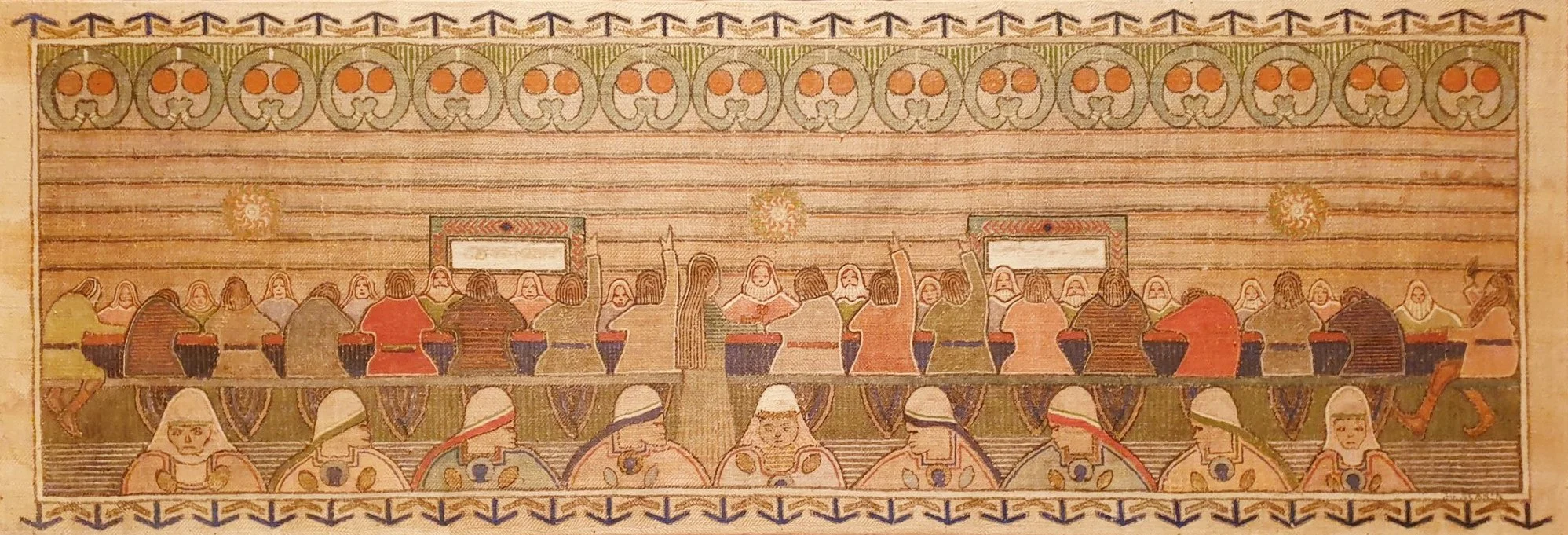
Joseph Alanen, The Feast of Pohjola
In scholarly terms, “lyric” is not a lesser category. It is a genre label for songs that often speak in a personal voice and dwell on affect, relationships, and everyday life. However, Finnish reception history coded lyric as domestic, feminine, and easier to sideline. This is visible in the long-standing imbalance between the Kalevala and the Kanteletar (a companion anthology gathering Kalevala-metre lyric and song-like poetry, often associated with everyday life and women’s voices). SKS’s own Tietävä learning site notes that the Kanteletar depicts especially the life and emotions of women, and that this lyric tradition has received less attention than the Kalevala’s heroic narratives. Scholarship has even recorded the Kanteletar being characterised in reception as “a little sister” to the Kalevala, making the diminution explicit. Today, research and performance are working to undo that inherited hierarchy, recognising women not as peripheral voices but as central tradition-holders within Kalevala-metre song.
One song that makes this unmistakably clear is “Kaik mie ilot unohin” - All my joys I have forgotten.
This is a women’s rune song in both theme and voice. It exists in many variants across Karelia and eastern Finland, not as a fixed text but as a family of expressions sharing the same emotional centre. Often the background is an unhappy marriage, the loss of youth, and displacement from one’s home. Marriage and exile appear again and again in women’s rune songs - not as dramatic events, but as slow, shaping forces.
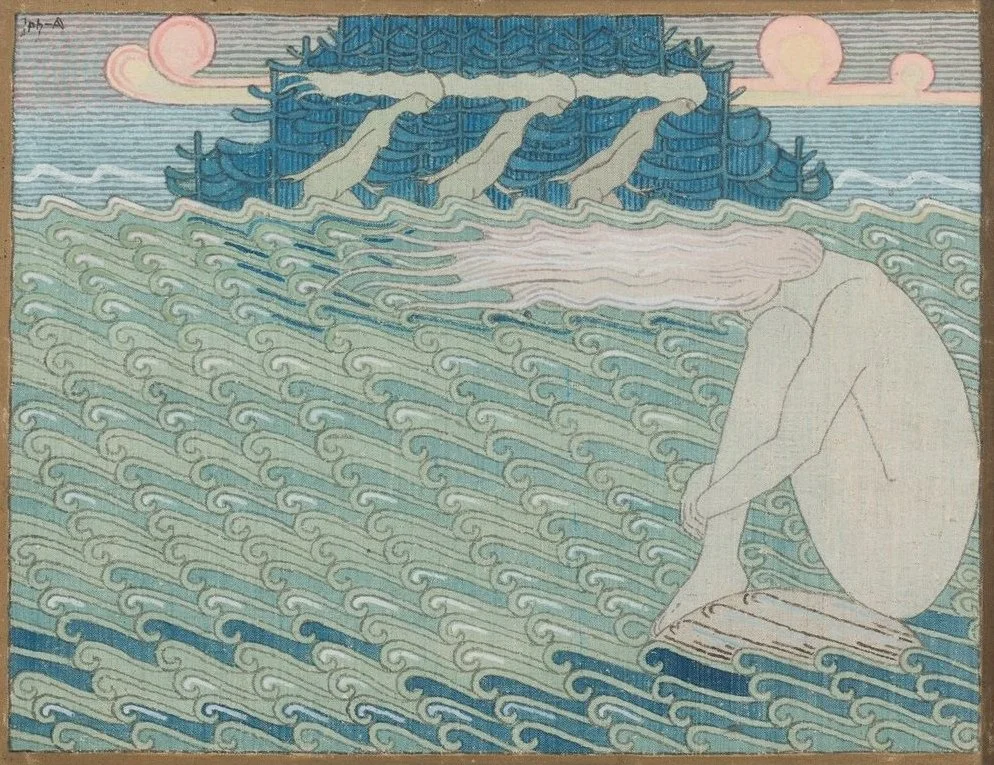
Joseph Alanen, Maidens at the Headlands
In ‘Kaik mie ilot unohin’ the woman has forgotten all her joys and ceased singing the songs she used to know - but she will never forget the following three: the place where she was born, her childhood friend, and her own mother. Most versions consist of four verses expressing roughly these lines. I had always found this song very moving, but it wasn’t until I came across a version consisting of eight verses that the floodgates truly opened. Instant welling up is something I personally take as a sign of needing to learn and share a song. Those verses revealed a lot more to this woman’s story and shifted my personal interpretation of it irreversibly.
This version clearly represents the voice of a young woman being married into exile. Starting with the same verses as the ones most commonly found, then proceeding onto wondering what the future might hold: “I know where I was born, but where will I die? Will I die on land or on the sea?” These anxieties made me aware of how recent history this kind of scenario is - even in a country like Finland currently known for its relatively equal society - and, more importantly, how this is still current reality for many women in the world. Marriage, instead of being a personal choice rooted in love and partnership, being something forced upon you, something that will fully change the course of your life against your will. The following line, “Or will I die out of domestic violence?”, drew my attention to an even more devastating fact: that this really is something we as women have to think about. In the last two verses she paints a picture of what happens to her after she dies: “The birds will lick my flesh, they will collect all my bones and the crow will take the bone of my big toe.”
Historically, songs like this served important functions. They were emotional release, public acknowledgement of suffering, a way to endure pain without denying it. Singing did not erase hardship, but it made space for it. The song carried what the body could not.
Without women’s songs, our picture of rune tradition would be profoundly incomplete. We would know how the world was created, but not how it was endured. We would hear the voices of heroes, but not the voices that carried everyday life forward. As a singer, I feel a responsibility to those voices. When I sing ‘Kaik mie ilot unohin’ I am standing in a long line of women who used their voices to survive, to be heard, and to remember.
Kerttu Sormunen