Medieval Singing Wasn't Straight

Sliding pitches. Pulsed notes. Tremblings. Repercussions. Notes that blur, shake, fold and slide. Medieval theorists describe all of them.
In his book The Sound of Medieval Song: Ornamentation and Vocal Style According to the Treatises, Timothy McGee reconstructs a vocal world of “enormous sound variety”. Medieval singing emerges not as a uniform vocal style, but as a practice shaped through intonation, vocal colour, ornamentation and improvisation, in ways that varied across regions and traditions. [1] Compare this with the sound that came to dominate recordings of medieval chant: what McGee describes as “a superimposition of modern Western conservatory vocal techniques and performance traditions on the early repertory.” Smooth, homogeneous, diatonic and closely bound to the page, he calls it “the antithesis” of medieval practice. [2]
The very idea of ornament could mislead us. In modern thinking, it can suggest a melody exists first, complete and stable, and that something is subsequently added to it. McGee reaches a much more radical conclusion:
“The entire early vocal style itself is ornamental.” [2]
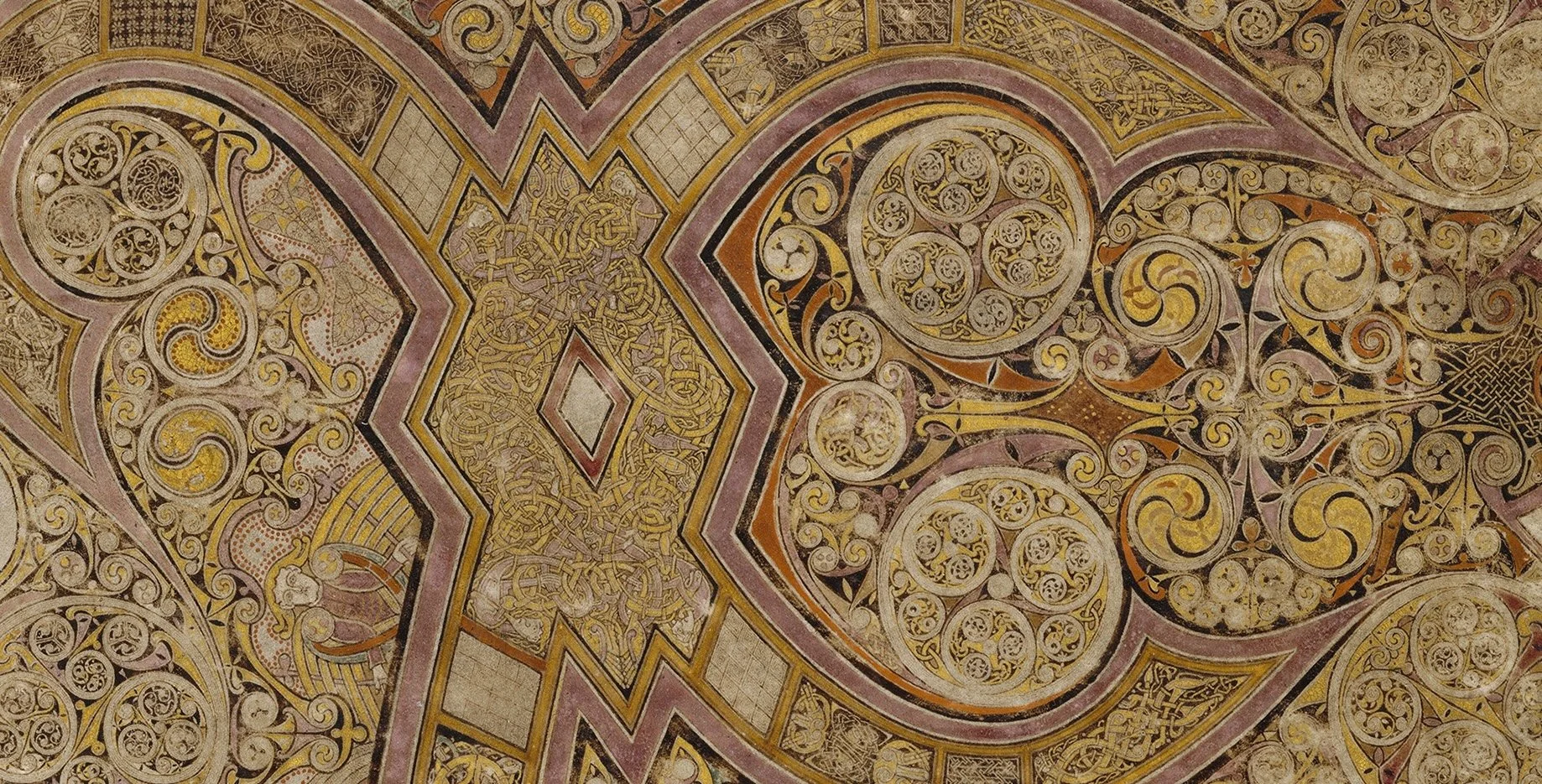
Book of Kells (Trinity College Dublin, MS 58), f. 34r, c. 800 - in the Chi-Rho monogram, writing and ornament become inseparable
At a recent workshop, while teaching Old Roman chant, I sang a clivis (descending two-note neume) with a traditional vocal placement and a small fold of the voice. This prompted a few surprised looks and several comments essentially asking: how can you justify doing that?
Medieval treatises suggest that inflection and gliding were basic features even in something as simple as a clivis: its second note could even be darkened, and the voice itself “bent” (vox debet inflecti) away from a perfectly fixed pitch. It is impossible to know exactly what each theorist meant by these descriptions, but the spirit of the practice is clear, and it finds powerful echoes in living oral traditions. Classical singing, as we know it, is a highly localised and recent phenomenon. Medievalist John Haines cites seventeenth- and eighteenth-century evidence that a free-floating larynx had been the norm in earlier singing; among its advantages was greater flexibility, particularly in rapid or difficult passages. [3] The smooth and relatively uninflected sound often associated with performances of medieval repertory belongs to a later vocal aesthetic; so too does the permanently lowered larynx of modern classical technique. Crucially, this history is social as well as technical. Ethnomusicologist Grant Olwage describes modern classical vocal culture as an attempt to “refashion identity at the most fundamental level”; in colonial settings, cultivated vocal production could “powerfully perform the erasure of difference.” [4] Vocal technique helped mark who sounded cultivated, civilised and modern, and who did not. So the straight tone cultivated in the conservatoire is not neutral; it carries histories of power and erasure into the room.
Medieval sources imagine the singer’s task differently. The eleventh-century chronicler Adhémar de Chabannes complained that French singers had learnt the Roman notes but could not reproduce their “tremblings” and “sweet subtleties,” their elisions and separations. [5] Singing the notes was not enough. The eleventh-century theorist Guido d’Arezzo writes that notes can “become liquid, like letters,” so that the interval between one note and the next is crossed fluidly, “without seeming to be delimited.” [6] The fourteenth-century theorist Johannes Boen records different “subdivisions of melody” (fracturam in cantu) among the English, French and Lombards. [7] Pitch inflections also appear in the notation itself: the Tonary of St Bénigne of Dijon (early eleventh century) marks microtonal pitches with five special signs, and microtonal notation appears in multiple Romano-Frankish manuscripts. [8] Around 1400, Arnulf of St Ghislain praises singers capable of dividing semitones into still finer intervals, producing an “indescribable melody” that seemed “more angelic than human.” [9] McGee explains that medieval singing allowed considerable freedom with pitch, including the substitution of one interval for another. He writes that “a minute variance of pitch is one of the desirable subtleties of vocal technique, and the performance of many of the written ornamental neumes includes the use of quarter-tones along with sound inflection.” [10]
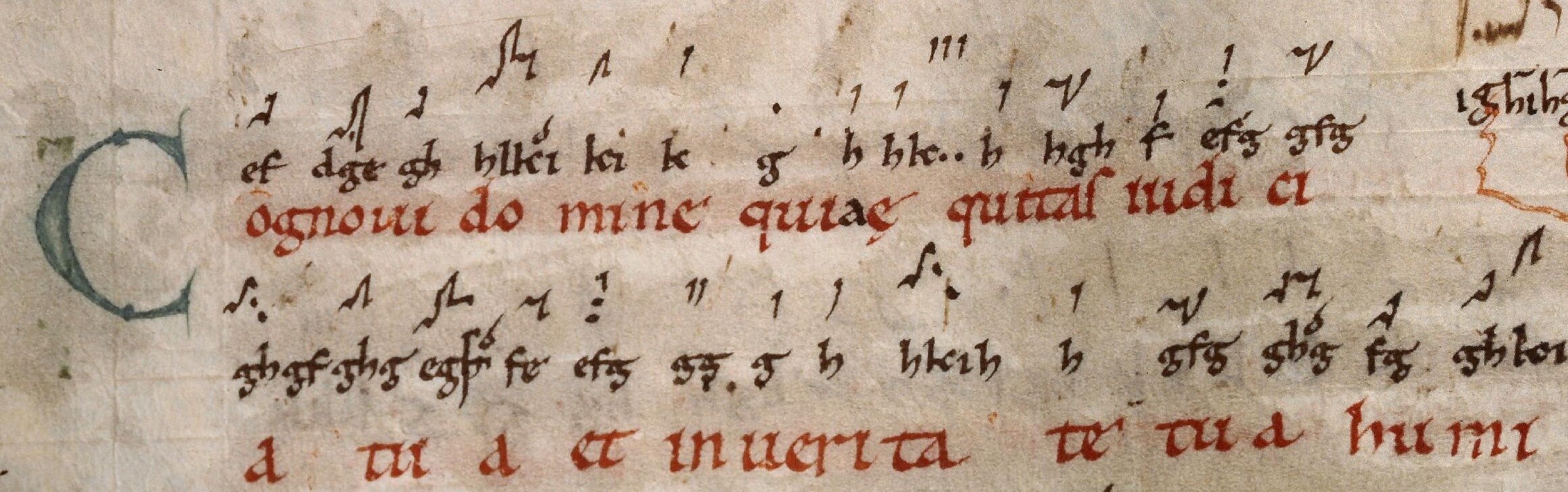
Montpellier Tonary, H 159, f. 25v - letters naming the pitches beneath the neumes made this manuscript a “Rosetta Stone” for deciphering unheighted notation and microtonal signs
During the workshop, another singer asked: why add ornaments on top of already notated ornaments?
I think we need to question these categories. The medieval singer was expected to animate the line: to give it colour, movement, articulation and energy. Should these subtle characteristics be called ornaments if, as McGee puts it, the entire early vocal style itself was “ornamental”? The details varied enormously across regions and centuries, but the sources repeatedly point to the same approach. Notation preserved only a trace of practices that exceeded the page and often preceded it. The term ornamentation might then be better reserved for more complex vocal gestures and larger acts of invention. Luca Ricossa quotes a Byzantine source suggesting how much musical knowledge was needed beyond the pitches themselves:
“I completed the ‘metrophonia’ of the First and First Plagal modes from the beginning to the end [...] and may God also make me worthy to learn the ‘melos’ so I chant it in my Country of Philippoupoli.” [11]
Metrophonia (μετροφωνία) supplied the pitches; melos (μέλος) brought them fully into performance. Note how melos requires work and worthiness. Here the realisation of a sacred score almost seems to necessitate or precipitate a spiritual realisation. Creative agency is not considered superfluous, it is the culmination of a convergence between score, performer, memory and spirituality. As the cantor conjures up multiple conscious and subconscious dimensions of tradition, heritage and remembrance, he expands the energy contained in an instant and escapes linear time towards a more spiritual plane. Contemporary performer-researcher Marcel Pérès calls this the “memory of the future”: singing as an augural act. [12]
This is why oral traditions matter. They preserve knowledge about what voices can do, ways of existing in time, in community and in the body; and in some cases, this includes complex practices of improvisation. Pérès writes of Corsican singers, for example, retaining precisely what notation leaves unstated: vocal emission, dynamics, intervallic value, tempo, melodic elaboration and polyphony. [13] Such traditions keep bodily intelligible things historical sources describe imperfectly in words. Early heterophonic and polyphonic practices are attested long before much of the written polyphony that survives, and by the fifteenth century counterpoint was still taught orally and realised through improvisation alongside plainchant and mensural music. Musicologist Philippe Canguilhem notes that theorists could understand musical creation as a “collective action in [live] process,” distinct from the production of a written work. [14] The written object belonged to a much larger ecology of memory, bodies and transmission.
The history of how these sounds and practices became foreign is far-reaching, but it is not the subject of this article. For present purposes, it is enough to recall that the Gregorian chant familiar today was profoundly shaped by nineteenth- and twentieth-century reform, especially at Solesmes. Although François Raillard had argued for the use of quarter-tones as early as 1858, liturgist Théodore Nisard dismissed liturgical microtones as “monstrosities” akin to the “meowing” of Arabic music. [15] As late as 1978, the Solesmes monk Dom Jacques Froger was still rejecting quarter-tone readings of Montpellier H159. [15] In 2018, Leo Lousberg observed that this rejection continued to shape scholarship:
“Froger’s rejection of microtonality in medieval Romano-Frankish chant reverberates in publications to this day. Still, authors are reluctant to mention microtones without the epithet ‘presumed’; some present their analyses as if the new insights gained after 1978 do not exist.” [15]

Cluny Gradual, BnF Latin 1087, f. 23v - a microtonal clivis over -rum, the final syllable of pauperum
In 2012, BBC Music Magazine described Ensemble Organum’s “aesthetic links” with traditions in Greece and the Middle East as an “ethnic effect” which, in one chant, “degenerates into simple bad singing.” [16] As recently as 2020, musicologist Edward Nowacki described the monophonic music of the Latin West as “solely indigenous.” [17] Yet the repertory itself says otherwise. Early Christian worship in Rome was Greek-speaking, and Greek remained audible in medieval Western chant. Western manuscripts preserve Greek and bilingual chants; Byzantine antiphons travelled through Francia to Rome; and in southern Italy, Latin chant developed in sustained contact with Greek monasteries shaped by Palestinian and Constantinopolitan traditions. Neil Moran has even traced the Palestinian chant Crucem tuam through Greek, Slavonic and Latin sources, including the Old Roman repertory. [18] [19] McGee’s study of medieval treatises, meanwhile, led him to the striking conclusion that North African vocal techniques were “basically the same as that promoted by Rome,” with elements of that vocal style still practised in different parts of Europe. [20]
Medieval music and living oral traditions reveal histories that are entangled, mobile and difficult to contain. Through singing and listening, these complexities can be encountered not only as ideas, but as something embodied and felt, disturbing inherited distinctions between centre and margin, self and other, modernity and the archaic. Medieval music has long participated in modern Europe’s invention of itself as the origin and measure of modernity; heard again in relation to diverse memories, geographies and spiritualities, it can now become a means of returning Europe to the world and, in Chakrabarty’s terms, of provincialising it. In that opening, medieval song can cease to be a conquered territory and become a place of realisation, encounter and possibility. Here, the words of María Menocal on the relationship between Arabic and European medieval literary history seem à propos:
“I have few delusions that it is any less a myth than those I am attempting to modify in the process, but I think it is a myth that has several advantages. The first is that it does not shy away from the concept of a mixed ancestry for Western Europe that until recently has seemed largely unimaginable and insupportable. The second is that I believe that it enriches rather than impoverishes the recounting of the story we already work with, the readings of texts we have already agreed on.” [21]
The Mediterranean is a geography of currents and crossings, porous frontiers and scattered islands, where no place is entirely its own. Medieval song behaves much the same way. In medieval literary studies, Paul Zumthor called this mouvance: “rather than a completed meaning, a constantly renewed practice of signification.” [22] Part of the difficulty, as Albert Lord observed, is that the contemporary mind struggles to “grasp anything that is multiform” and remains dissatisfied with “an ever-changing phenomenon.” We must therefore give up the search for purity and, with it, the idea of an untainted original. In the spirit of medieval music, I would rather spend a lifetime earning my freedom through the discipline of oral tradition, in which “each performance is an original.” [23]
Dr Thomas Fournil
More examples of medieval singing on our Instagram: Templar chant, Sibylline melody, three-voice polyphony, trobairitz song, Old Roman chant, and another trobairitz song.
Notes
Timothy J. McGee, The Sound of Medieval Song: Ornamentation and Vocal Style According to the Treatises (Oxford: Clarendon Press, 1998), esp. introduction and chs. 3-5; Timothy J. McGee, “‘Ornamental’ Neumes and Early Notation,” Performance Practice Review 9, no. 1 (1996), 56-61.
Timothy J. McGee, The Sound of Medieval Song: Ornamentation and Vocal Style According to the Treatises (Oxford: Clarendon Press, 1998), introduction and conclusion.
John Haines, “Lambertus’s ‘Epiglotus’,” The Journal of Medieval Latin 16 (2006), 162.
Grant Olwage, “The Class and Colour of Tone: An Essay on the Social History of Vocal Timbre,” Ethnomusicology Forum 13, no. 2 (2004), 207, 219.
Adhémar de Chabannes, cited and translated in McGee, “‘Ornamental’ Neumes and Early Notation,” 62.
Guido d’Arezzo, Micrologus, ed. Marie-Noëlle Colette and Jean-Christophe Jolivet (Paris: Éd. IPMC, 1993), xv.
Johannes Boen, cited and translated in McGee, The Sound of Medieval Song, 89.
Leo A. G. Lousberg, Microtones According to Augustine: Neumes, Semiotics and Rhetoric in Romano-Frankish Liturgical Chant (Utrecht University, 2018).
Arnulf of St Ghislain, Tractatulus de differentiis et gradibus cantorum, trans. Christopher Page, Journal of the Royal Musical Association 117, no. 1 (1992), 1-21, esp. 16, 20.
McGee, The Sound of Medieval Song, ch. 4, “Graces.”
Gregorios Stathiscites, cited in Luca Ricossa, “Hyeronimus de Moravia: Ornamentation and Exegesis in Gregorian, Old Roman, and Byzantine Chant,” lecture, International Congress on Medieval Studies, Kalamazoo, MI, 7 May 2006, 4.
Marcel Pérès, “¿Que podría ser la hermenéutica de la música?”, X Encuentro Música-Filosofía, Ronda, 2013.
Marcel Pérès, Le Chant religieux corse: État, comparaisons, perspectives (Créaphis, 1996), 69-82.
Philippe Canguilhem, “Improvisation as Concept and Musical Practice in the Fifteenth Century,” in The Cambridge History of Fifteenth-Century Music, ed. Anna Maria Busse Berger and Jesse Rodin (Cambridge University Press, 2015), 149, 156; Fabrice Fitch, Renaissance Polyphony (Cambridge University Press, 2020), 18.
Katherine Bergeron, Decadent Enchantments: The Revival of Gregorian Chant at Solesmes (University of California Press, 1998); François Raillard, Emploi des quarts de ton dans le chant de l’Église (Paris: Impr. de Lahure, 1858); Théodore Nisard, L’Archéologie musicale et le vrai chant grégorien (Paris: Lethielleux, 1890), 174; Dom J. Froger, “Les prétendus quarts de ton dans le chant grégorien et les symboles du ms. H.159 de Montpellier,” Études grégoriennes 19 (1978); Leo A. G. Lousberg, Microtones According to Augustine: Neumes, Semiotics and Rhetoric in Romano-Frankish Liturgical Chant (Utrecht University, 2018), 33.
Anthony Pryer, review of Ensemble Organum, École Notre-Dame de Paris, BBC Music Magazine, 20 January 2012.
Edward Nowacki, Greek and Latin Music Theory: Principles and Challenges (University of Rochester Press, 2020), 1.
Uwe Michael Lang, The Roman Mass: From Early Christian Origins to Tridentine Reform (Cambridge University Press, 2022), ch. 4; Nina-Maria Wanek, “Musical Transfer Processes between Byzantium and the West,” research project, University of Vienna, 2015-2020; Edward Nowacki, “Constantinople-Aachen-Rome: The Transmission of Veterem hominem,” in De Musica et Cantu: Studien zur Geschichte der Kirchenmusik und der Oper. Helmut Hucke zum 60. Geburtstag, ed. Peter Cahn and Ann-Katrin Heimer (Hildesheim: Olms, 1993), 95-115; Peter Jeffery, “Eastern Elements in Western Chant: a Second Look over a Changed Landscape,” Plainsong & Medieval Music 34, no. 1 (2025), 11-23.
Neil K. Moran, “A Second Medial Mode Palestinian Chant in Old Roman, Beneventan and Frankish Sources,” Plainsong and Medieval Music 19, no. 1 (2010), 1-19.
Timothy J. McGee, The Sound of Medieval Song, 152.
María Rosa Menocal, The Arabic Role in Medieval Literary History: A Forgotten Heritage (University of Pennsylvania Press, 1987), 16.
Paul Zumthor and Michel Zink, Essai de poétique médiévale (Paris: Éditions du Seuil, 2000), 94.
Albert B. Lord, The Singer of Tales (Cambridge, MA: Harvard University Press, 1960), 100.