Remembering Armenian Chant
Lucine Musaelian is a singer and vielle player with Idrîsî Ensemble and led a session in our Arts Council England-supported free workshop series on Armenian sacred chant. Here, she reflects on her own experience of Armenian liturgy, oral tradition and khaz notation. Hear Lucine singing Armenian chant HERE, HERE and HERE.

Like many diasporan Armenians, I grew up hearing the Armenian liturgy. Chants from the altar were answered by the choir and decorated by the rattling of the censers. Those standing in the pews would be encouraged to join the choir at times, especially during the “Lord’s Prayer” hymn. The only moments of speaking occurred during certain readings of the Bible and the sermon, but otherwise, even the Gospel was sung. This ritual of sound, though deeply familiar, still wore a veil of mystery into my adult life. The liturgy is almost entirely conducted in գրաբար (“grapar”), or Classical Armenian. The dialect uses the same alphabet, but different grammar and vocabulary, almost like Shakespearean English, or how Latin is to Italians. Without developing knowledge of the liturgy and “grapar” language, it can be difficult to follow.
The music of the Armenian liturgy today is the culmination of centuries of ancient chant, combined with the recent Westernisation of the choral hymns. It feels as though the songs of the priests, deacons, and acolytes are preserved in time. Their chants are taught and learned by ear, passed down through centuries of oral tradition. They are unaccompanied, and sung in a natural way that highlights the text. Priests and deacons with more vocal agility ornament important words in a traditional, and somewhat improvised manner. The role of the contemporary Armenian church choir, however, is much more fixed. Composers Makar Yekmalyan and Komitas Vardapet composed and notated their versions of the Divine Liturgy in the late 19th and early 20th centuries respectively. Both composers studied in European conservatoires, and notated the music in Western staff notation. Moreover, they harmonised the Armenian monody, creating the first real Armenian choral music. Organ is now regularly integrated in a tradition that was always exclusively vocal.
These versions of the Armenian liturgy are the most commonly used in churches today, both in Armenia and throughout the diaspora. The choral chants themselves are beautiful, filled with written-in, traditional Armenian ornaments and still observing Armenian church modes. At the same time, it is difficult to ignore the contrast between what is sung at the altar and what is sung by the choir. The choir is meant to represent and guide the congregation. Traditionally, the whole congregation responds to the chants of the priests and deacons. But with a notated and harmonised choral part, the gap between the ability of the choir and congregation increases, affecting the unifying spirit of congregational prayer.
In our workshop sessions, I wanted to explore ancient chant that still survives in the church today to understand how it might have been passed down both orally and in various forms of notation, and to better understand the role of the choir and congregation prior to the 19th Century. First, we looked at a chant by Mesrop Mashtots, a 5th Century linguist and theologian who invented the Armenian alphabet, helped translate the Bible into Armenian, and also wrote various liturgical works. “Bazum en Ko gtutyunqd” (Բազում են Քո գթութիւնդ), translates to “Your mercies are many”. This syllabic chant did not have any musical notation associated with it in its original documentation, but in later manuscripts you can see the use of khaz notation: an Armenian neume notation that began its development in the 8th century.
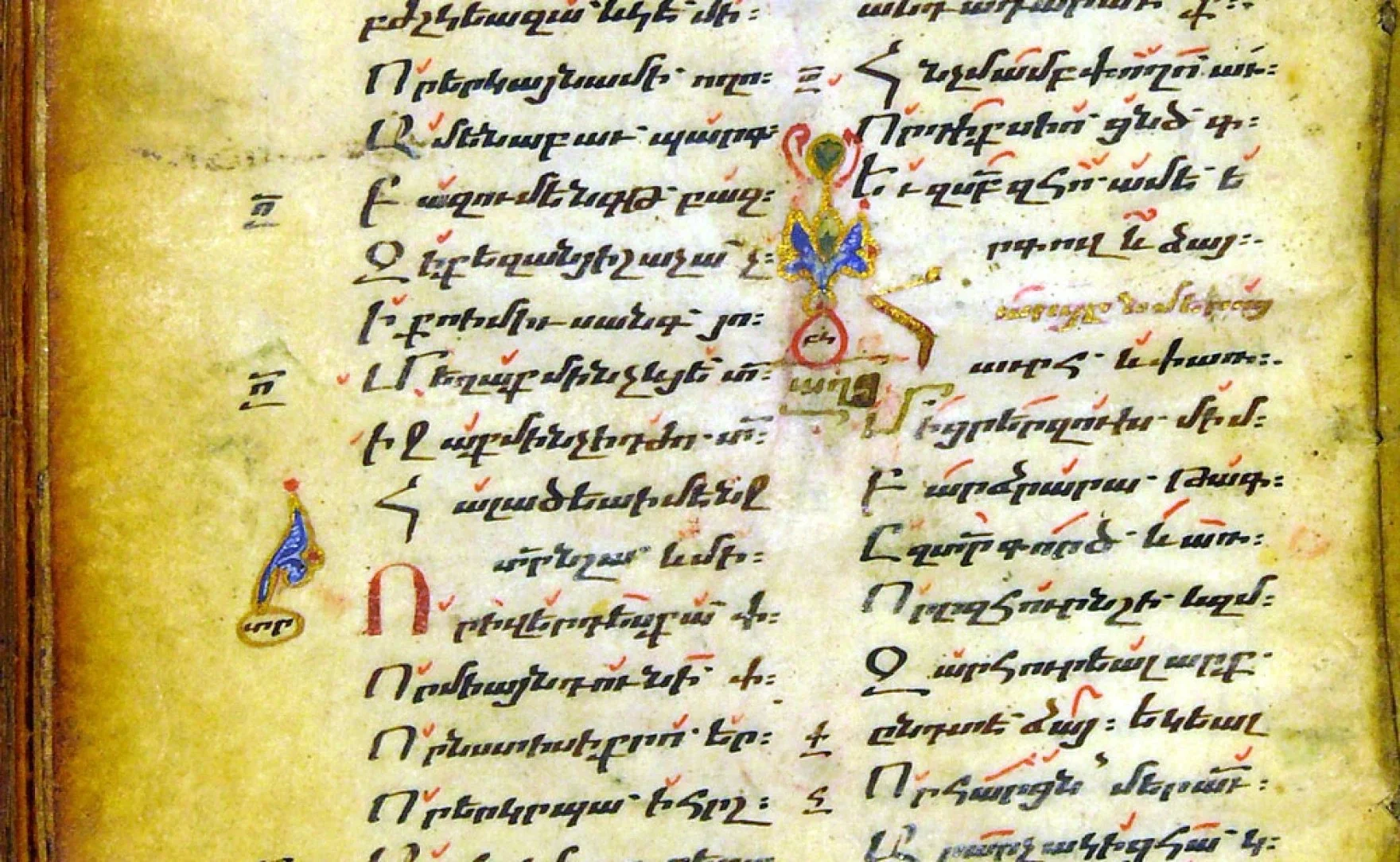
This particular manuscript featuring “Bazum en Qo gtutyunqd” only has the first phrase of each line of the chant, along with red “khaz” marks that indicate inflections in the melody. In this case, the notation serves as a memory aid, as it would be impossible to recreate the chant through notation alone. Since this particular chant is not melismatic, the notation can be simple.
There are examples of Khaz notation that illustrate much more detail in the melody. For example, this 10th century Alleluia fragment:
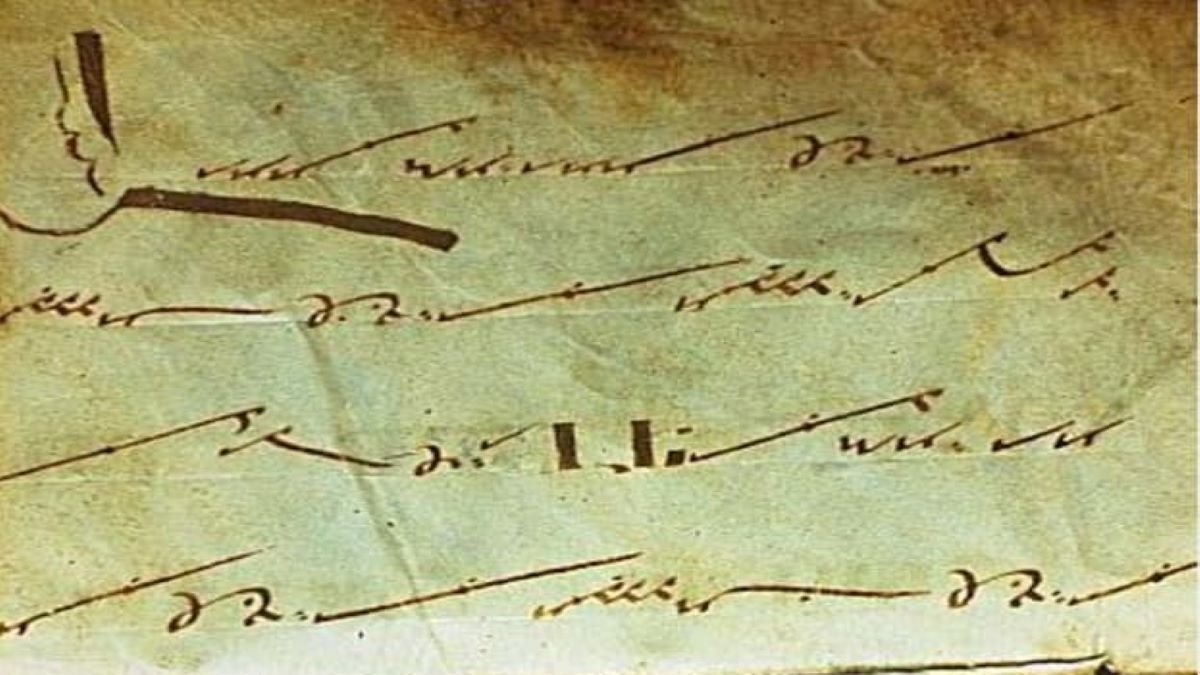
Khaz notation in a medieval Armenian manuscript, 10th century. Mesrop Mashtots Matenadaran, Yerevan.
The letters in bold, ‘Ա’ and ‘Լե’ (‘A’ and ‘le’) are the only bit of text. Every other marking is a khaz, which represents the melismatic, highly ornamented melody. Because the use of khaz notation was so varied between churches, regions, and centuries, there is no fixed interpretation of this particular fragment. Even leading expert Aram Kevropyan is not sure what it is meant to sound like, especially as this version is not known to have survived through oral tradition. Still, these markings, combined with lived practice and tradition, tell a story of how music transforms through centuries.
In his lifetime, the composer, priest, and ethnomusicologist Komitas Vardapet (1869-1935) transcribed and notated thousands of traditional Armenian folk and sacred pieces across many regions. He was deeply knowledgeable in khaz notation and often used it as a way to preserve sacred works. Since khaz notation is not widely used or understood anymore, Western notation became his main mode of disseminating sacred music. He transcribed the famous 10th Century chant “Havoon havoon” by Grigor Naregatsi (c. 950) from various khaz manuscripts, creating a standardised version. Preserving this piece with such precise rhythms, on the one hand, is incredibly useful. It freezes Komitas’ educated interpretation in time, ensuring that the piece does not get lost in oral tradition. On the other hand, it standardises something that for centuries, has been adaptable and moveable, without a strictly “correct” music. It also falls under a diatonic notation system that does not capture the use of microtones and the freedom in ornamentation.
As modern interpreters of this rare and endangered music, our goal should be to use notation as a memory or learning aid, while also drawing on the oral traditions and cultural lineages to which the music belongs. We should allow ourselves to explore personal interpretations that fit our voices and serve modern contexts, while also respecting and understanding the history of this music. The preservation of ancient music should not mean freezing it in a fixed form, but understanding it deeply so that it can continue to live and evolve over time.
Lucine Musaelian